









Chicago’s supply-starved apartment market is forcing developers and investors alike to get creative.
The lack of new units in the city’s inventory is bolstering underlying fundamentals and is drawing some big bets on large acquisitions, as well as a growing number of office-to-residential conversions that are fueling a large chunk of the pipeline, panelists said at the Bisnow Multifamily Annual Conference Midwest on Thursday, held at the Radisson Blu Aqua Hotel.
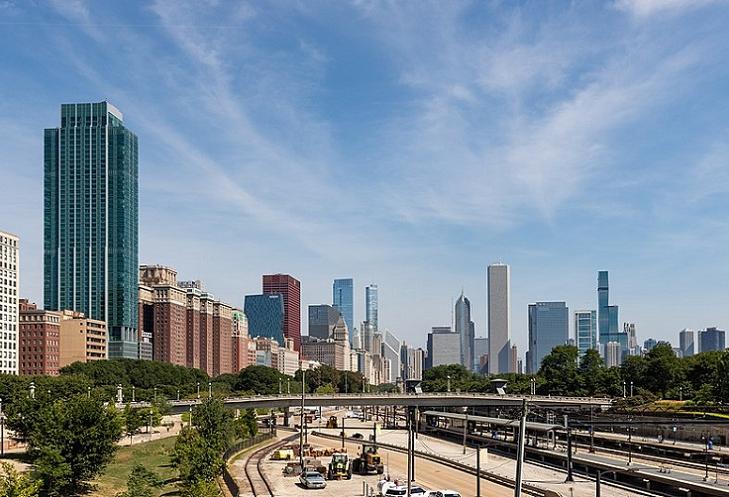
The Chicago skyline from Grant Park
The overall downtown pipeline is still fairly dry — there were just under 5,300 units under construction as of June 30, 843 units delivered in the first half of 2026, and another 861 units expected to come online through the end of 2026, according to Cross Street.
“One of the reasons I love Chicago for a developer is there’s very little competition,” Mavrek Development CEO Adam Friedberg said.
LaTerra Cos. CEO Charles Tourtellotte, whose California-based firm made a major acquisition at the end of last year when it scooped up a nearly 1,500-unit multifamily portfolio for $455M, said the supply constraints in the market made for a good formula for the deal. He said the properties have occupancies in the low to mid-90% range, and lease trade-ups are running between 5% and 7%.
Tourtellotte said he is as happy as he could be about the deal right now.
“This portfolio in particular was attractive because it had 4% interest-only assumed financing,” Tourtellotte said. “If you go in, buy at a six cap … and you have interest-only financing at about a four, that means there’s promising cash flow coming out of the deal.”
Tourtellotte said that while you can make a case in Chicago that rents have kept pace with construction costs for new developments, it is harder to do so in other markets.
Adaptive reuse projects make up a significant portion of the slow downtown development pipeline. These projects are slated to account for about 44% of all units delivered downtown in 2026, with 117 already delivered and 823 units under construction, according to Cross Street.
Mavrek Development is converting 65 E. Wacker Place from a historic office building into 252 luxury apartments. Friedberg said residents will begin moving into the building in a few weeks. The building is about 27% preleased, even though the developer has been touring potential tenants with hard hats through a construction site with no lobby.
Friedberg said nothing is getting cheaper to build, regardless of interest rate movements, because building materials and labor costs don’t significantly decrease over time.
Acres Commercial Realty CEO Mark Fogel, who partnered with Mavrek on the 65 E. Wacker deal, said that as a lender who sees properties from all over the country, he isn’t seeing much rent growth anywhere except New York and Chicago.
“Here, it hasn’t gotten way out of balance,” he said. “I don’t think it’s supply and demand, but we’re still not able to make it pencil. It’s interest rates and costs for us.”
Friedberg said if new development is to make financial sense in Chicago, it has to be either a very big project, which developers may be able to use tax credits to build, or a really small one where developers can save on labor costs. In general, Friedberg said Mavrek targets around 7% return costs and finds investors long on Chicago so they can sell when market conditions are most favorable.
“I don’t know if there’s ever been a bigger opportunity in real estate than office conversion,” Friedberg said. “When else in our lives have we seen a bunch of extremely well-located, already built buildings where they’re empty? From a real estate perspective, I think everyone here would agree that they should serve an alternative use. Now, the hard part is: what use is that?”
Source link