










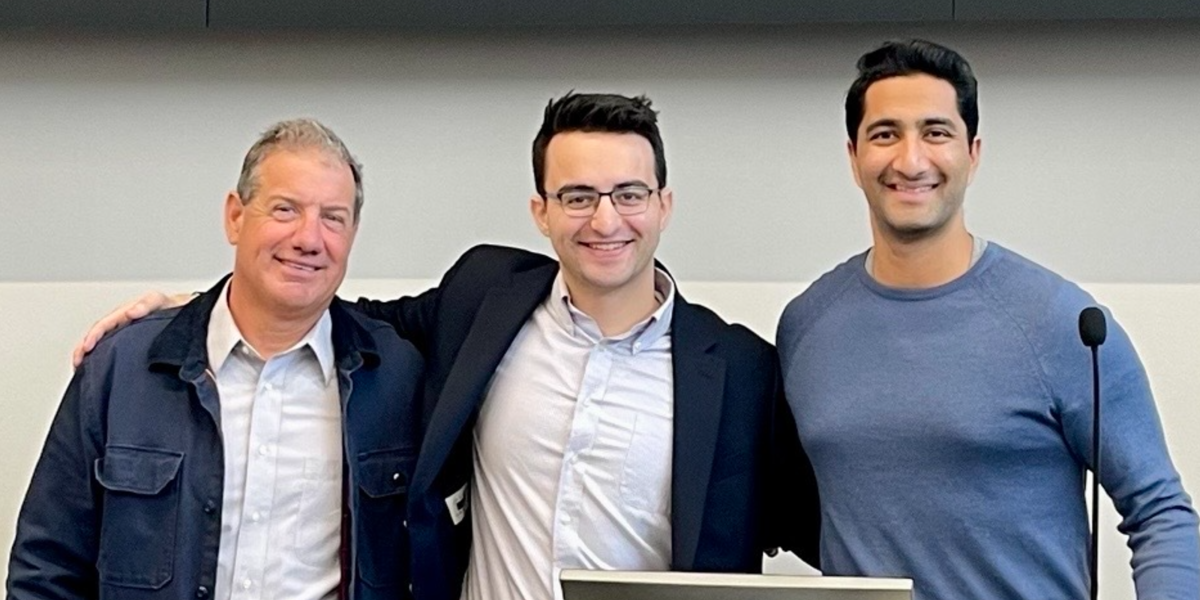
David Lawrence was a Harvard Law student when an on-campus shooting involving a police officer sparked intense controversy over police conduct. Realizing that most policing errors occur when officers lack instant access to department rules, Lawrence dropped out to tackle the problem with AI. He teamed up with co-founders Amit Patankar, a Harvard MBA and former Google engineer, and Michael Gropman, a retired Boston police deputy chief, to launch Blue Voice—a Boston-based AI startup that provides real-time policy guidance to officers in the field.
Three years later, Blue Voice is coming out of stealth with $6 million in funding led by SignalFire and Las Olas VC. Officers at 225 county agencies across 25 states now rely on the tool daily to ensure their actions follow department protocol—a platform Lawrence likens to Harvey, the AI tool widely used by lawyers, or OpenEvidence, which is a similar tool for doctors.
“When an officer makes a decision, they do so from memory or best guess, based on thousands of pages of law, policy, municipal ordinances, and state laws that they’ve internalized and keep in their head,” Lawrence told TechCrunch.
Before Blue Voice, an officer who couldn’t recall a specific protocol—like the exact seventh step required at a crime scene—had few good options: flip through a 15,000-page manual, wake up a supervisor in the middle of the night, or search generic tools like Google or ChatGPT that lack police-specific training. The problem was that traditional methods took too much time, while consumer AI models delivered incorrect answers up to 30% of the time, Lawrence said.
Blue Voice says it solves this issue because it is trained on department-specific laws, local ordinances, protocols, and guidelines that general-purpose AI tools can’t access on the public internet. The platform also gives officers instant access to detailed school maps on their phones during active-shooter emergencies.
Today, Blue Voice answers a question every minute. Lawrence says that officers feel confident relying on the tool because it always points them directly to original regulations rather than just generating an answer on its own the way ChatGPT would. Rather than dictating actions, the tool simply provides the laws, leaving the final decision to the officers, who combine it with their own field experience.
Over the last year, says Lawrence, Blue Voice grew its customer base elevenfold because police departments see concrete results, including reduced crime and fewer operational controversies.
Blue Voice recently helped prevent a kidnapping after a rookie officer spotted a man pressuring a young girl to enter his vehicle, according to Lawrence. Unsure whether he had legal grounds to intervene, the officer consulted Blue Voice on his phone. The app instantly confirmed that the situation met the legal criteria for “child enticement” — an offense covering attempts to lure a minor for the purpose of committing a crime against them — giving him the immediate authority to act.
In another instance, Blue Voice reminded a department chief that he couldn’t return an officer to active-duty following a shooting without first obtaining a third-party mental health evaluation.
The startup competes, which competes with PE-backed Lexipol, also recently developed functionality to help detectives solve cold cases.
At a time when police use of AI—such as Flock Safety’s license plate surveillance systems—draws growing criticism, Lawrence hopes Blue Voice proves that properly deployed AI can deliver public safety benefits without sacrificing civil rights.
Lawrence, who previously worked for Connecticut Governor Ned Lamont, developed a deep passion for public service and says he has no regrets about leaving law school behind. “This is the best thing I could do with my career and the most impact I could potentially make,” he said.
Above, left to right: Michael Gropman, David Lawrence, and Amit Patankar.
When you purchase through links in our articles, we may earn a small commission. This doesn’t affect our editorial independence.
Source link