










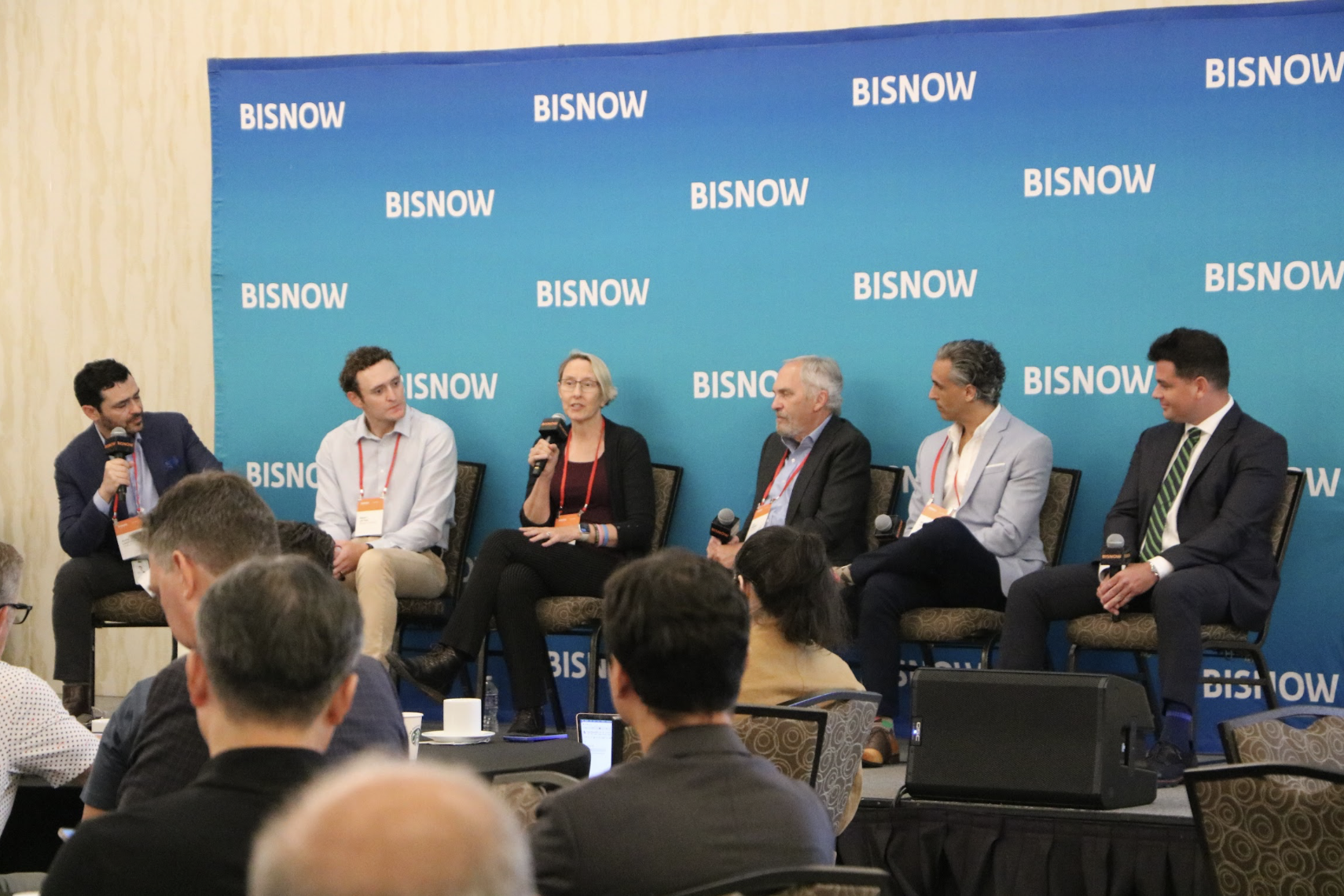
Bisnow/Sam D’Angelo
Carlton Fields’ Alon Lagstein, Mogul Capital’s Brent Layton, Villa’s Heather Miksch, Decro’s Ted Handel, Consolidated Investment Group’s Benjamin Levy and Impact Housing’s Drew Orenstein
Factory‑built housing may finally be getting the regulatory and financial tailwinds it has long lacked. After years of being treated as a niche construction method, Southern California modular developers say lenders and lawmakers are beginning to clear the bottlenecks that kept off-site construction stuck at the margins.
Lenders are getting more comfortable with the product type, and new regulations are clearing the way, according to panelists at Bisnow’s Southern California Prefabrication, Modular and Off-Site Construction Conference.
“Lenders have come a long way in terms of their comfort level with modular,” Impact Housing CEO Drew Orenstein said at the event, held Aug. 26 at the Hilton Los Angeles Culver City.
Orenstein, whose company has completed projects that range from about 40 units to nearly 500 units, said a variety of lenders across the spectrum have stepped up to partner on his company’s projects.
“We worked with a debt fund on those larger projects, but then we worked with regional banks and then national banks on the affordable side,” Orenstein said. “There’s a lot of good backing there as well.”
:quality(75))
Bisnow/Sam D’Angelo
US Offsite’s Ryan Spitz, Logos Development’s Arthur Lin, Nibbi Prefab’s Randall Thompson, Clark Pacific’s Vincent Polhemus, Harbinger Production’s Jamie Hiteshew and Assemblage-Works’ Michael Mathews
Prefabricated housing is often touted as a way to reduce skyrocketing construction costs and shorten completion timelines, but a number of factors, including financing challenges and disjointed regulations, have been blamed for dragging down the construction type’s ability to scale. It makes up about 5% of construction activity in “key market segments,” according to the Modular Building Institute.
Recent legislation at the federal and state levels seeks to reduce barriers for factory-built housing, both for single-family and multifamily projects.
The federal Road to Housing Act became law in mid-July and included a provision directing the Department of Housing and Urban Development to identify barriers to financing modular housing and study whether a federal standardized building code for modular housing would make an impact on the construction type’s adoption.
Orenstein was also hopeful about a piece of California legislation from assemblymembers Buffy Wicks and Juan Carillo, who represent parts of the Bay Area and the High Desert, respectively.
The first-of-its-kind bill would allow the state to reinsure modular projects. California would insure the insurers on these projects, allowing them to get the surety bonds that more traditional construction relies on to mitigate risks on a project and provide the certainty that a complete project will be delivered.
As the bill language explains, because modular is less common than stick-build projects, getting those bonds is often challenging.
:quality(75))
Bisnow/Sam D’Angelo
AO’s Ioanna Magiati, oWow’s Danny Haber, The Michaels Organization’s Raoul Amescua, Avanath Investment & Development’s Keith Harris and Dignity Moves’ Jeff Spahr
“I think it will really help with some of the bonding criteria and increase people’s appetite for working with modular manufacturers,” Orenstein said of the Wicks and Carillo regulation, which has passed both houses of the state legislature and now heads to Gov. Gavin Newsom.
Modular projects generally also require more upfront funding, as traditional financing models are really based on a more common, stick-build construction project where pieces gradually come together on the same site.
For affordable developer Decro, the need for money upfront to pay for completed modules was a challenge on top of building affordable housing with its web of financing sources.
Some developers using off-site construction in their projects have had success educating their financing partners.
“I always think that the most productive way to go into it is to have your lender and the modular production company in their room at the same time while you’re negotiating contracts, because the loan documents and the production contract need to be harmonious,” Mogul Capital Vice President Brent Layton said. “You do not want conflicts.”
Source link